
WhatsApp Business API pricing used to confuse people because it was billed per conversation. That is no longer how it works. On 1 July 2025 Meta switched to per-message billing, and in January 2026 India moved to rupee billing. If you are still working off a conversation-based estimate, your budget is wrong in both directions. Here is the current picture.
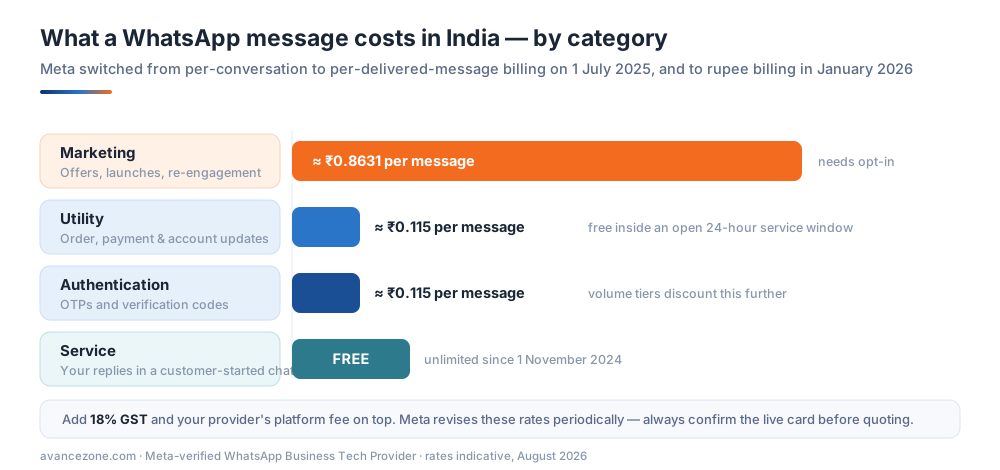
You are billed per delivered template message
Every template message your business sends is charged individually, priced by the category it falls into. The old idea that "one charge covers everything for 24 hours" is gone. What survives from the conversation model is the 24-hour service window — the period after a customer messages you, during which your replies are free.
The four categories and what they cost in India
| Category | Indicative rate | What it covers |
|---|---|---|
| Marketing | ₹0.8631 / message | Offers, launches, festival campaigns, win-back |
| Utility | ₹0.115 / message | Order, payment and account updates tied to a customer action |
| Authentication | ₹0.115 / message | Login OTPs and verification codes |
| Service | Free | Your replies inside a chat the customer started |
Rates are Meta's, indicative as of August 2026, and exclude GST and your provider's platform fee. Meta revises them periodically — Indian marketing rates rose roughly 10% in the last revision.
The three things that are not in that table
GST. 18% applies on top of Meta's rate and on your platform fee. A ₹0.8631 marketing message is closer to ₹1.02 landed.
Your provider's platform fee. Every Business Solution Provider charges for the API, dashboard, chatbot builder, team inbox and support. Some charge a flat monthly fee; many add a per-message markup of 10–30% on top of Meta's rate. Ask which model you are on, because the second one scales with your volume in a way the first does not.
Volume tiers. Utility and authentication rates fall as your monthly volume grows — meaningfully so at scale. If you are sending hundreds of thousands of OTPs, the list rate is not the rate you should be paying.
Free is a bigger category than most people realise
Two rules do most of the cost-saving work:
Service messages are free and unlimited, and have been since 1 November 2024. If a customer messages you first, everything you send back within 24 hours costs nothing.
Utility messages are free inside that same open window. So an order update sent right after a customer asks "where is my order?" is free, while the identical message sent cold two hours later is billed. Sequencing matters.
Click-to-WhatsApp ads are worth knowing about for the same reason: a tap on the ad opens a free 72-hour messaging window.
A worked example
Take a Coimbatore retailer in a normal month: 5,000 order and dispatch updates, 2,000 login OTPs, and one festival campaign to 8,000 opted-in contacts.
- Utility: 5,000 × ₹0.115 = ₹575
- Authentication: 2,000 × ₹0.115 = ₹230
- Marketing: 8,000 × ₹0.8631 = ₹6,905
That is about ₹7,710 in Meta charges, before GST and platform fee. Note where the money is: the 8,000-message campaign costs more than eight times the 7,000 operational messages combined. Marketing is roughly 7.5× the price of a utility message, which is the single most useful ratio to carry in your head.
Now move half those order updates inside an open service window — send them as a reply to a customer's tracking query rather than as a cold push — and the utility line drops to about ₹288. Tighten the campaign list from 8,000 to the 5,000 who have actually bought in the last year and marketing falls to ₹4,316. Same business, same month, roughly ₹2,900 saved by sequencing and segmentation alone.
How to estimate your own bill
Count the messages, not the customers. For each category, estimate monthly volume, multiply by the rate, add 18% GST, then add your provider's fee. Do it per category rather than as one blended number — otherwise a marketing campaign hides inside an otherwise cheap utility estimate and the invoice surprises you.
Is WhatsApp always cheaper than SMS?
No, and any provider who tells you otherwise is selling. An authentication message at ₹0.115 is in the same territory as a transactional SMS, and SMS needs no app, no internet connection and no prior opt-in. For OTPs to a first-time user, SMS is often still the right call — which is why banks send both. The sensible design is WhatsApp where the customer is engaged, SMS as the fallback when WhatsApp cannot be delivered.
Get an accurate quote
AvanceZone is a Meta-verified WhatsApp Business Tech Provider and runs its own SMS gateway, so we can price both channels honestly and set up automatic fallback between them. See WhatsApp Business API in Coimbatore for the full 2026 rate table, or request a demo and pricing.